
YUI’s Combo Handler CDN Service
Eric Miraglia wrote a post yesterday called Combo Handler Service Available for Yahoo-hosted JS. One of the advantages of YUI over other JavaScript frameworks is its à la carte capabilities. Developers can choose just the parts they want, rather than being saddled with the whole kit and caboodle. It’s great to download fewer bytes, but choosing a subset of modules results in downloading multiple external scripts, something that’s bad for performance and costs YSlow points. That’s where Eric’s post comes in.
The Combo Handler Service lets developers choose a customized subset of modules and have them served as a single HTTP request from Yahoo!’s worldwide CDN for faster delivery. Each module (file) is listed in the querystring. As an example, Eric shows that loading the YUI Rich Text Editor the old way would require downloading six separate scripts:
<script src=”http://yui.yahooapis.com/2.5.2/build/yahoo-dom-event/yahoo-dom-event.js”>
</script>
<script src=”http://yui.yahooapis.com/2.5.2/build/container/container_core-min.js”>
</script>
<script src=”http://yui.yahooapis.com/2.5.2/build/menu/menu-min.js”>
</script>
<script src=”http://yui.yahooapis.com/2.5.2/build/element/element-beta-min.js””>
</script>
<script src=”http://yui.yahooapis.com/2.5.2/build/button/button-min.js”>
</script>
<script src=”http://yui.yahooapis.com/2.5.2/build/editor/editor-beta-min.js”>
</script>
This is reduced to a single HTTP request by using the Combo Handler:
<script src=”http://yui.yahooapis.com/combo?2.5.2/build/yahoo-dom-event/yahoo-dom-event.js&
2.5.2/build/container/container_core-min.js&2.5.2/build/menu/menu-min.js&
2.5.2/build/element/element-beta-min.js&2.5.2/build/button/button-min.js&
2.5.2/build/editor/editor-beta-min.js”>
</script>
It’s important that developers using Combo Handler pay particular attention that they get the dependency order correct. I created the YUI Combo Handler: preserving order test page to show what happens if prerequisites are listed incorrectly. In this page instead of putting editor-beta-min.js as the last querystring parameter, I make it the first parameter. Not surprisingly, the page produces JavaScript errors. It would be great if Combo Handler ensured that the response had all the necessary prerequisites in the right order. With this enhancement the single request would be much simpler:
<script src=”http://yui.yahooapis.com/combo?2.5.2/build/editor/editor-beta-min.js”>
</script>
This is a great announcement. Web developers using YUI can now get a customized rollup hosted on Yahoo!’s CDN! This is the best of all worlds – reduced download size, fewer HTTP requests, and CDN hosting. I encourage other JavaScript frameworks to adopt YUI’s à la carte flexibility. Perhaps Google Ajax Libraries could then support features to serve up customized builds similar to what Combo Handler does. Well done.
Velocity Wrap-up
This week I co-chaired Velocity, the web performance and operations conference from O’Reilly. It was great! Jesse and I told the story about how the conference came about. When we proposed the conference we believed there was a community of performance and operations engineers that needed a forum to share and learn, and the attendance at Velocity confirmed this. Velocity sold out with over 600 attendees!
The lineup of speakers was great. There was a lot of material packed in a 2-day conference. I stayed in the Performance track, but wanted to attend every session in the Operations track, too. Many speakers shared their slides, and there are videos and photos from some of the talks.
Google AJAX Libraries API
Today Dion Almaer announced the Google AJAX Libraries API. This is a great resource for developers using any of the popular JavaScript frameworks including Prototype, Script.aculo.us, jQuery, Dojo, and MooTools. Rather than downloading it to your own server and hosting it from there, you can request your preferred JavaScript library from ajax.googleapis.com:
 <script src="http://ajax.googleapis.com/ajax/libs/jquery/1.2.6/jquery.min.js">

</script>
The greatest benefit in my opinion is that any developer can leverage Google’s CDN to deliver the bulk of their JavaScript. From YSlow and my book I received a lot of feedback that Rule 2: Use a CDN was out of reach for many developers. I use jQuery in one of my personal projects and serve it on my hosted web site from one geographic location. Ouch. Being able to move that 21K closer to my users is great.
Splitting the Initial Payload
This post is based on a chapter from Even Faster Web Sites, the follow-up to High Performance Web Sites. Posts in this series include: chapters and contributing authors, Splitting the Initial Payload, Loading Scripts Without Blocking, Coupling Asynchronous Scripts, Positioning Inline Scripts, Sharding Dominant Domains, Flushing the Document Early, Using Iframes Sparingly, and Simplifying CSS Selectors.
The growing adoption of Ajax and DHTML means today’s web pages have more JavaScript than ever before. The average top ten U.S. web site[1] contains 252K of JavaScript. JavaScript slows pages down. When the browser starts downloading or executing JavaScript it won’t start any other parallel downloads. Also, anything below an external script is not rendered until the script is completely downloaded and executed. Even in the case where external scripts are cached the execution time can still slow down the user experience and thwart progressive rendering.
Every line of JavaScript code matters to a fast loading page. And yet, as shown in Table 1, the average top ten U.S. web site only executes 25% of the JavaScript functionality before the onload event.[2] Why track this relative to the onload event? Any code needed after the onload event (for dropdown menus, Ajax requests, etc.) could be downloaded later, making the initial page render more quickly.
High Performance Web Sites, Part 2
In my first book, High Performance Web Sites, I presented 14 rules for making web pages faster. I’ve got some good news and some bad news. Bad news first: there are more than 14 things you have to do to speed up your pages. The good news is I’ve started another book that describes more best practices for web performance. The working title is High Performance Web Sites, Part 2. Here’s the set of rules I have so far:
- Split the initial payload
- Load scripts without blocking
- Don’t scatter scripts
- Split dominant content domains
- Make static content cookie-free
- Reduce cookie weight
- Minify CSS
- Optimize images
- Use iframes sparingly
- To www or not to www
Cuzillion
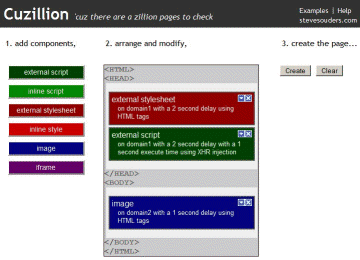
At Web 2.0 Expo today I announce the release of Cuzillion. The tag line is ‘cuz there are zillion pages to check. It’s indispensable for people like me who are always pushing browsers to their limit trying to figure out how to squeeze out a little more performance.
I’m constantly thinking of or being asked about how browsers handle different sets of resources loaded in various ways. Before I would open an editor and build some test pages. Firing up a packet sniffer I would load these pages in different browsers to diagnose what was going on. I was starting my research on advanced techniques for loading scripts without blocking and realized the number of test pages needed to cover all the permutations was in the hundreds. That was the birth of Cuzillion. (more…)
O’Reilly Webcast
This Thursday, April 24, at 10am PDT I’m doing a webcast entitled “Even Faster Web Sites”. This is a new type of event for O’Reilly and I’m excited to try it out. I’ll do 30 minutes of talking with online slides and demos, followed by questions from listeners. There is a limit to the number of people who can attend, so please register in advance.
Web 2.0 Expo
I’ll be speaking at Web 2.0 Expo in San Francisco April 25 at 1:30pm. My talk is called Even Faster Web Sites. This is my next set of performance best practices including how to load scripts without blocking and the dangers of inline scripts. If you’re thinking of coming please the discount code “websf08sbg” to save an extra 10%.
Roundup on Parallel Connections
A lot of blogging and follow-up discussion ensued with the announcement that IE8 supports six connections per host. The blogs I saw:
- IE8: The Performance Implications
- IE8 speeds things up
- IE8: 6 Connections Per Host
- IE 8 and Performance
- Testing IE8.s Connection Parallelism
- IE 8 Connection Parallelism Issues
It’s likely that Firefox 3 will support 6 connections per server in an upcoming beta release, which means more discussion is expected. I wanted to pull all the facts into one place and make several points that I think are important and interesting. Specifically I talk about:
- the HTTP/1.1 RFC
- settings for current browsers
- upperbound of open connections (cool!)
- effect of proxies
- will this break the Internet?
IE8 speeds things up
IE8 Beta 1 has several performance improvements listed in the release notes. Many of these improvements center around the DOM and JavaScript execution. And their announcement about stricter standards compliance is a great move forward. There are three changes that are big and relate to my performance best practices: 6 downloads per hostname, loading scripts in parallel (the biggest improvement!), and support for data: URIs.