
Velocity wrap-up
Velocity ended yesterday at 6pm – and the final presentations from 5:20-6:00 were still packed! It was a great conference. I’m wiped out from talking web performance from 8am to 10pm the last three days.
The highlight of the conference was the conference itself:
- 1200 attendees
- 89 speakers
- 28 sponsors
- 26 exhibitors
Compare that to the numbers for Velocity 2008: 600 attendees, 65 speakers, 9 sponsors, 17 exhibitors. The growth is a testimonial for how the focus on web performance and operations has increased in just 2 years. Companies know their web sites have to be fast, available, and scalable. That’s why they come to Velocity.
We added a third track this year on Culture which meant I wasn’t able to attend every performance talk. But here are the talks I saw that really stood out:
- Creating Cultural Change (video) and TCP and the Lower Bound of Web Performance (slides) – John Rauser (Amazon) was the breakthrough speaker of the conference. Both talks not only had great content, they were also funny and delivered with style.
- Datacenter Infrastructure Innovation (video) – James Hamilton (Amazon) presents surprising stats about the true costs of infrastructure services.
- Speed Matters (video) РUrs H̦lzle (Google) evangelizes creating a faster web via a long list of performance initiatives. Make sure to check out the links at the end to SSL and congestion window improvements.
- The O’Reilly Radar (video, slides) – Tim O’Reilly leads the rally cry for the critical role of performance and operations to the future of the Web.
- Don’t Let Third Parties Slow You Down (video, slides) – Michael Kleber (Google) presents some great stats on the impact of 3rd party content, and at the end slips in some performance improvements he’s working on for Google AdSense.
- JSMeter: Characterizing Real-World Behavior of JavaScript Programs (slides) – Ben Zorn (Microsoft Research) reveals how unrepresentative today’s benchmarks are compared to real web sites. I really recommend you check out his charts.
- Building Performance Into the New Yahoo! Homepage (slides) – Nicholas Zakas (Yahoo!) provided a case study of adding advanced performance techniques including progressive enhancement.
There were other great talks such as The Top 5 Mistakes of Massive CSS and Google Maps API v3 – Built First for Mobile for which we’re still waiting for slides and possibly video. I encourage you to check out all the slides and videos – remember, I was only able to sit in on one of three tracks. There’s a lot more to see.
Thanks for making Velocity 2010 so amazing. I’ll see you at Velocity 2011! (Remember to register early!)
Velocity OLC, upcoming events
Velocity is the O’Reilly conference Jesse Robbins and I co-chair. This is our third year and it’ll be bigger and better than ever. Dates are June 22-24. We’re almost done reviewing proposals and the speaker line-up so far looks great: mobile, browsers, tools, JavaScript, metrics, and more all covered from a performance perspective. I hope you’ll be able to make it.
As a warm up to Velocity in June, O’Reilly had the great idea of starting Velocity OLC (OnLine Conference). We had the first one on December 8 with great speakers including Mike Belshe (Chrome, SPDY), Charles Jolley (SproutCore), and J Chris Anderson (CouchDB). The next Velocity OLC is coming up fast – March 17 9-11:15am (PST). The agenda is:
- Site Performance in Google Webmaster Tools – Sreeram Ramachandran (Google)
- MySQL Abuse – Kellan Elliott-McCrea (Flickr)
- Keeping Track of Your Performance Using Show Slow – Sergey Chernyshev (truTV)
- Provisioning Toolchain – Lee Thompson (DTO Solutions)
- Diagnose and Prevent JavaScript/AJAX Performance Issues in Internet Explorer – Andreas Grabner (dynaTrace Software)
The event is free! I invited the performance speakers, Sreeram, Sergey, and Andi, because they’ve released these amazing, free tools that all web developers focused on performance should know about. I hope you’ll tune in.
I also want to mention my next few speaking appearances.
JSConf.US (April 17&18, DC) – I missed the first two years of this conference and was bummed. I heard so many good things about it, I jumped at the chance to speak at JSConf.EU last November in Berlin and it exceeded my high expectations. Now I get to experience the main event. And I’ll be back in my old (20 years ago) stomping grounds!
Web 2.0 Expo San Francisco (May 3-6) – This event is sentimental for me. 4 years ago Tenni Theurer and I showed up to do a workshop on Sunday. It was beautiful outside and we figured everyone would be out sightseeing. Instead, 300+ people showed up. That was the first conference I had spoken at in a decade, and was the beginning of the evangelism campaign that I carry on today. I’ve spoken here every year and it’s always a great, smart crowd. Super hallway discussions.
@media (London, June 8-11) – Dion and Ben turned me on to Web Directions, speaking highly of all the conferences they run. I reached out to John Allsopp and he was kind enough to put me on the speaker list. I’m pysched to see some of the speakers I know well, plus some I’ve never met. And it’s a great opportunity for me to touch base with EU web devs focused on performance. Use the “SOUDERS” discount code.
Definitely grab me if you’re at any of these events. I want to know about your biggest performance bottleneck, and tips & tricks you’d like to share. And I’m always happy to sit down with a packet sniffer and do some performance analysis on the fly.
Zen and the Art of Web Performance
The Zen Wall
We moved into a teardown 2BR/1BA house in 1993. After two years of infrastructure repairs (heating, plumbing, electrical, doors, windows) we started work on the yard. One of the jobs that I enjoyed most was building a dry stone retaining wall in the front yard. Here are the before and after pictures:

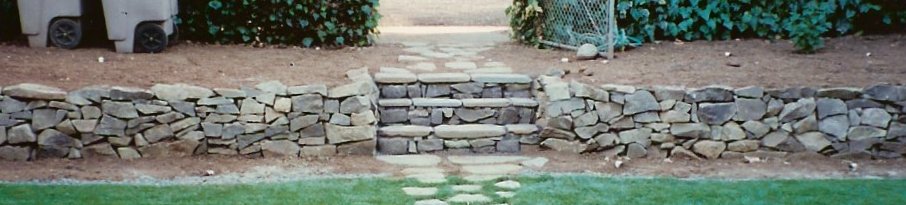
During this multi-month project my neighbor, Les Kaye, came by to survey the progress. Les is the Zen monk at the Kannon Do Zen Meditation Center and author of Zen at Work. He made a comment about my rock wall that I’ve always remembered – “very Zen-like”.
I’m not a Zen student, but I have read a few Zen books (Les’ Zen at Work, Tao Te Ching by Lao Tsu, the Tao of Leadership by John Heider, and Zen and the Art of Motorcycle Maintenance by Robert Pirsig). I think Les’ comment had to do with the way I was building the wall. I wasn’t using any tools, and didn’t have any drawings or plans. I had never built a dry stone wall before. I read a few articles on dry stone construction, got advice from the folks where I bought the stone, and then just started.
I had a sense of where the wall should go in the yard, and where the steps should go in the wall. I laid the base, and then worked up from there. I would try a few stones for a given spot until I found the right one. I could recognize if a stone worked, and if it didn’t. Sometimes I’d have to backtrack a bit to undo some bad stones and start over where the good stones left off. In the end, the wall turned out great. It’s now covered with moss, overhung by rosemary, and filled with lizards that come out to sunbathe in the summer.
Les’ comment that my rock wall project was Zen-like had to do with this marriage of an artistic sense of what was right with the technical process of building a wall. The separation of art and technology, and the need to rejoin them, is a major theme in Zen and the Art of Motorcycle Maintenance that’s been on my mind lately.
Art & Technology
The way I approached this rock wall project seems a bit ill-conceived. You certainly wouldn’t run a software development project this way. A well-planned project would make use of good tools. It would have a detailed plan. It would include people that had experience, at least in a consulting role. And it would have regular milestones that could be objectively measured and quantified. But these (technical, mechanical, objective) process parts aren’t sufficient to ensure success. A sense of craftsmanship is also needed.
I’ve had the experience where I’ve hired a home contractor who had all the right tools and experience, and was equipped with an agreed upon plan, but at the end of the job I wasn’t satisfied with the outcome. The end result didn’t fit. It was out of proportion – something we couldn’t have noticed looking at the plans. Or it didn’t fit the flow of the people living in the house – the light switches were placed in an awkward location in a counter intuitive order, or the door swung out too far and blocked traffic.
I’m not saying you shouldn’t have plans and tools, and metrics and experts. And I’m certainly not running down home contractors – many great contractors have worked on our house. I’m saying that the high quality results I’ve experienced resulted when technical skills were combined with a sense of what was “right” in the work. Robert Pirsig says it this way in describing a wall built in Korea:
[The wall] was beautiful, but not because of any masterful intellectual planning or any scientific supervision of the job, or any added expenditures to “stylize” it. It was beautiful because the people who worked on it had a way of looking at things that made them do it right unselfconsciously. They didn’t separate themselves from the work in such a way as to do it wrong. […] In each case there’s a beautiful way of doing it and an ugly way of doing it, and in arriving at the high-quality, beautiful way of doing it, both an ability to see what “looks good” and an ability to understand the underlying methods to arrive at that “good” are needed.1
Beautiful Web Performance
My work on web performance has helped identify the “underlying methods” for arriving at a quality result in terms of a fast web site. To make it easy to find out which methods to use, I created YSlow and encouraged the team that launched Page Speed. But these tools don’t preclude the need to understand the techniques behind web performance. I was reminded of this today by an email I received through my web site. The emailer said he had installed YSlow and saw what needed to be fixed, and asked for the step-by-step instructions on how to accomplish these changes.
Without any details of his web site, HTML & JavaScript frameworks, etc. it was impossible to generate step-by-step instructions. But even if it was possible, if he had followed someone else’s list of instructions he would be separated from the work and miss the experience of the “beautiful way of doing it”. Optimizing a web site isn’t something that can be undertaken without understanding what you’re changing and why. Doing so inevitably introduces complexity, confusion, and loss of quality. It would be better for him to develop that understanding, or if that’s not possible to use a framework that incorporates performance best practices.
In addition to an understanding of the underlying methods, the ability to see what “looks good” is also needed, as Pirsig says. When it comes to web performance, it’s pretty easy to distinguish the good from the bad. How does your site feel when you use it? How about when you use it from home or from a mobile device? WebPagetest.org helps by offering multiple ways to visualize the performance of your web site, and to compare that to other sites.
Over time, combining an understanding of the underlying methods for web performance with an ability to see what “looks good” leads to doing quality development “unselfconsciously”. It becomes second nature, and permeates every site you build. As I read Zen and the Art of Motorcycle Maintenance I was amazed at how well it spoke to the work I do, even more amazing given that it was published in 1974. The search for Quality is timeless. I recommend you read ZMM, or read it again as the case may be. Raising the level of quality in your work will benefit your users and your employer, but it’ll benefit you most of all.
1Robert M. Pirsig, Zen and the Art of Motorcycle Maintenance An Inquiry Into Values (P.S.) (New York, Harper Perennial Modern Classics, 2005) p. 298.
Stuck inside Classic Rock
Help! I’m trapped inside Classic Rock and can’t get out!
I grew up in the 60s and 70s listening to what is now called “classic rock”. My first album was Creedence Clearwater Revival’s Cosmo’s Factory. Ramble Tamble is still one of my favorite rock songs. I bought that album when I was 10 years old. I wish I was that cool but I was (am) not – my next album was The Partridge Family Album.
Through my teenage and college years I listened to the bands that make up every classic rock playlist: Allman Brothers, Grateful Dead, Rolling Stones, The Who, Steve Miller, Lynyrd Skynyrd, Bruce Springsteen, Led Zeppelin, Tom Petty, etc. I don’t listen to Partridge Family any more, but I listen to these other bands every day. My iTunes library is full of this music. My default station on both Pandora and Slacker is “Classic Rock”. And my main radio station is KFOG, home of “world class rock”.
Even though I love classic rock, I do like to mix in some new music now and then. New music that’s cut from the same mold, that is. Some new bands I’ve added over the years include Counting Crows, U2, and Red Hot Chili Peppers. That shows how old I am. I think of U2 as “new” – a band that’s been together for 30 years. I desperately needed some truly new music, so I grabbed the copy of Rolling Stone featuring the decade’s best songs & albums and went searching.
I found some great new (10 years old or less) music, and wanted to share what I found. What’s this have to do with web performance? I’ll get to that at the end. If you don’t want to wade through my music recommendations, skip to the bottom and find out what the connection is.
“New” Classic Rock
Here are singles I added via iTunes:
- Wake Up by Arcade Fire – Theme song from the Where the Wild Things Are movie. You should listen to this song first thing every morning when you get up.
- Take Me Out and No You Girls by Franz Ferdinand – Great lyrics to a good euro beat. Maybe danceable, but also capable of generating some headbanging.
- Hurt by Johnny Cash – Johnny Cash covers Nine Inch Nails?! I had to listen to this and was hooked. With lyrics like “what have I become” and “empire of dirt” it makes you think.
- One More Time by Daft Punk – Electro-disco dance mix. Play this in the car when the sun’s out and the windows are down, or the next time a dance party breaks out in your living room (whichever comes first).
- Paper Planes by M.I.A. – I’m not huge on hip-hop, so I fell short of buying the album. But this catchy song featured in Slumdog Millionaire is a great addition to the playlist. My daughters and wife liked it – bonus points!
- Float On by Modest Mouse – Singer Isaac Brock sounds like David Byrne in this song that mixes driving choruses with melodic lyrics.
- Last Nite by The Strokes – A rocking song that’ll get you moving.
I buy my CDs on Amazon. Just this week a buddy predicted the music industry would soon stop making CDs. I hope not. I have so much music it’s overwhelming. I like holding a collection of songs in my hand, taking it with me in the car or on a trip, looking at the cover art, and reading the liner notes. All of this helps me better capture a mental picture of the music. I also believe artists arrange songs together and in a particular order to achieve additional impact. True or not, I like physical CDs. Here’s what I bought:
- Fleet Foxes by Fleet Foxes – This was an easy, almost backward, transition from classic rock to new music. These guys sound like CSNY – harmonies and easy lyrics. Good listening.
- Funeral by Arcade Fire – I bought the single of Wake Up on iTunes and then got it again when I bought the CD – not smart. But it was worth the extra $0.69 to have that one song for the few days it took for the album to arrive.
- A Rush of Blood to the Head by Coldplay – Coldplay churns out hits, which is a turnoff for me. This album has hits, or at least songs you’ll recognize, like In My Place, The Scientist, and Clocks. But the lesser known songs on this album are what’s intriguing – Politik, God Put a Smile upon Your Face, Green Eyes – let’s face it, all the songs on this album are good or great.
- Yoshimi Battles the Pink Robots by The Flaming Lips – Wow. Incredible and hard to describe. It feels like someone used a Pink Floyd machine to translate a comic book to music. I listened to Flight Test and Yoshimi Battles the Pink Robots, Pt. 1 multiple times each day when I first got this. You can hear the influences from Cat Stevens (Flight Test) and Neil Young (In the Morning of the Magicians).
- Only by the Night by Kings of Leon – You’ll recognize the track Use Somebody. I like the singer’s voice – it reminds me of Bob Seeger.
- Z by My Morning Jacket – Southern rock meets Hothouse Flowers, with some early Who influence.
What’s the Connection?
It has been a few weeks since my last blog post. I’m having a hard time getting going again after the long holiday break. This blog post on classic rock was an easy first step back into the world of blogging.
But there’s more to it than that.
I’m slow getting back into blogging because I’m having trouble imagining putting down words that have value. Over the break I read Zen and the Art of Motorcycle Maintenance by Robert Pirsig (for the third time). My mind is still swimming from the visions and thoughts stirred up by that book. Having experienced what an author is capable of with words, how can I attempt to do anything even remotely similar? I am not worthy!
It gets worse, or at least more complicated.
As I drive around listening to my “new” classic rock, I get the same overwhelming, swimming feeling. Many of these songs move me. They’re beautiful. Even the headbanging songs are beautiful. They’re beautiful in the way the artist has reached through the car stereo speakers and changed the way I feel. They’re beautiful in the way they connect and convey. Just like ZMM is beautiful and connects and conveys. And I stop and ask myself – Is my blog beautiful? Really what I mean is, can my blog connect and convey?
I’ve spent a lot of time over the last year thinking about and observing how we connect with each other through writing, music, art, movies, personal interactions, and the Web. I’ve been thinking about what makes those connections more successful, more enjoyable, and ultimately more moving. For my world I’ve been concerned with what makes a blog post, tech presentation, book, or piece of code more beautiful. It came down to asking and defining – What is Beauty? And that’s when I hit a brick wall. I couldn’t define it. I know it when I see it. I can experience it. But I can’t define it. How can I improve something I can’t define?
As I read ZMM, I realized this was similar to Phaedrus’ struggle to define Quality. And the connection Phaedrus found between Quality and what the Greeks called aretê, or Excellence, is similarly connected to what I have been calling Beauty, and is probably a better name for what I’ve been searching to improve. Quality, Excellence, and Beauty – they’re all the same, or at least closely related.
Quality, excellence, and beauty are, or at least should be, in our work. And that’s the connection. This music is excellent and beautiful, and I want to find that quality in the world of web performance, and find a way to express it and communicate it, and have all of us carry it with us as we do our work. As I read ZMM, I saw many similarities between web performance and motorcycle maintenance. I feel like there’s at least one more blog post on the topic, if not an entire book. Hmmm, Zen and the Art of Web Performance. I like it. But let’s see how the blog post goes first. Stay tuned…
Velocity CFP now open!

Velocity 2010 is just around the corner!
Well, actually, it’s not until June 22-24, 2010. But Jesse and I have already been working with the O’Reilly conferences team for a few months. We have the venue – Hyatt Regency Santa Clara. We have the theme – Fast by Default. We have the cool blur motion speed image. The Program Committee signed on for another year: John Allspaw, Artur Bergman, Scott Ruthfield, Eric Schurman, and Mandi Walls. We’re already fielding calls from sponsors and exhibitors. The next step is speakers. That’s where you come in.
The Call for Participation for Velocity 2010 just opened today. We want to hear proposals for web performance and operations topics that you’re passionate to share. Some suggested areas include:
- Web frameworks with built-in performance
- Effective cloud computing
- Profiling web applications (esp. JavaScript)
- Network performance – HTTP, TCP, DNS
- NoSQL
- Mobile performance
- Evangelizing performance within your company
This is Velocity’s third year. The first two years were incredible. I’d love to see you at this year’s conference. If you’ve been working on something that other SpeedGeeks should hear about, submit a proposal now.
Øredev, Fronteers, JSConf.eu
A contingent of web dev gurus are on their way to Europe the first week of November for some awesome conferences. If you haven’t signed up, check into it soon – seats are going fast.
The gurus I’ve been coordinating with include John Resig, Doug Crockford, Ben Galbraith, and Dion Almaer. But there’s more! Other speakers/friends who I’m excited to techdown with are Christian Heilmann, PPK, Nicole Sullivan, Richard Campbell, Kyle Simpson, and Tom Hughes-Croucher.
The conferences (in chronological order) are:
- Øredev (Nov 2-6, Malmö, Sweden) – Malmö is right across the channel from Copenhagen. I’ve never been to Denmark or Sweden, so am psyched to check this out (and bring back some legos).
- Fronteers (Nov 5-6, Amsterdam) – This is what started it all for me. I heard the reviews of Fronteers 2008 and swore I was going to go this year. I have a lot of respect for PPK’s work, and am honored he asked me to present. I visited Amsterdam a few times and loved it, but it’s been 15 years so I’m excited to get back. Unfortunately, Fronteers 2009 is already sold out! If you didn’t get a ticket, check out one of the other conferences.
- JSConf.eu (Nov 7-8, Berlin) – I heard great things about JSConf in DC and wanted to get to know this group. It’s great that it follows so closely after Fronteers. My ancestors came from Germany, so I look forward to visiting Germany again.
I’ll be presenting at all three conferences, giving away a few books, and sitting down with developers in these countries to discuss the tech challenges they face, and hopefully pick up some best practices, especially with regard to performance.
I am so psyched for this trip! My wife and kids are bummed they’re not coming, so I can’t show any excitement at home. (Luckily, my wife doesn’t read my blog – don’t tell her how excited I am!) All three of these conferences are going to be great. I hope to see you there!
jQuery Conference and The Ajax Experience
I’m heading out on the red-eye tonight for Boston. I’ll be there for three action-packed days!
Sunday morning I’m speaking at jQuery Conference ’09. Monday afternoon I’m doing a talk at The Ajax Experience. Both conferences look great. I’m excited to share what I know and talk with other web developers to find out their latest discoveries and also pain points, especially with regard to web performance. I’ll be giving away free copies of Even Faster Web Sites and will be announcing two new open source projects.
If you’re at either conference, please say “hi”.
OSCON and Page Responsiveness videos
I had a great time at OSCON a few weeks back. It was in San Jose this year. (Pro: I don’t have to travel and my wife can go to the parties. Con: I miss Portland.) Just as I wrote about last year, Gregg Pollack was there asking speakers to summarize their talks in 30 seconds. He published the results in the video series 5 Days of OSCON. I’m in the video for Day 3.
Gregg also pointed me to his Page Responsiveness webcast/video, where he talks about YSlow and the Google Ajax Libraries API. I really like this video. It’s informative, engaging, and short. They remind me of Aza Raskin’s webcasts on Ubiquity and Jetpack. These two guys are very talented in how they convey complex information in a hands-on way. I encourage you to take a look.
Fronteers 2009
I’m psyched to be speaking at Fronteers in November – and not just because it’s one of the best conference names ever. And not just because it’s in Amsterdam – although that is a huge plus. The main reason I’m psyched is because I missed last year’s conference and regretted it. The feedback I got was that the speakers were great and so were the attendees. PPK is active in his advocacy for frontend engineering, and (from what I heard) that was apparent in the level of knowledge and participation shown throughout the talks.
Last year’s speakers included Stuart Langridge, Christian Heilmann, and Pete LePage (check out the links to their talks on YDN). PPK has announced myself and Nate Koechley as speakers for 2009, and some other web gurus I know have said they’re speaking there as well. It’s going to be another great set of speakers and sessions. I’m so glad that I’ll be there to experience it, and I hope you can make it, too.