
Velocity Farewell
Velocity Origin Story
In 2007, my first book, High Performance Web Sites, was selling very well. That, plus the launch of YSlow, brought more attention to web performance. As a result, Jon Jenkins invited me to give a tech talk at Amazon. Afterward, he, John Rauser, and I, plus a few other performance-minded folk, had a great dinner and spirited discussion about performance best practices. Jon asked me if there was any place where people got together to have that type of discussion. I couldn’t think of one so promised to talk to O’Reilly about the idea of a conference.
I emailed my editor, Andy Oram, and asked if he thought a performance conference was a good idea. He agreed to setup a meeting with Tim O’Reilly at OSCON. That meeting included people that I would end up working closely with for the next decade: Tim, Andy, Gina Blaber, Brady Forrest, Jon Jenkins, Artur Bergman, and Jesse Robbins. (There were others there as well and I apologize for not remembering.) I’m not sure, but I think Jon invited Jesse to the meeting. Both of them worked at Amazon where Jesse was the “master of disaster” – helping to create a resilient infrastructure for their services.
We discussed the idea of a conference combining performance and operations. It made sense. Both groups (or “tribes” as Jesse called them) focused on optimization. The tools and stacks might have been different, but the mindset was the same. The first Velocity was held June 2008. Jesse and I were the co-chairs. I remember being surprised and grateful when Gina called me to ask if I would co-chair. It seems like that was a long time ago.
Take a look at the speaker list for that first Velocity – it contains many people who were or would become luminaries in emerging fields of DevOps and WPO – Web Performance Optimization (aka, FEO – Frontend End Optimization):
- John Allspaw – future Velocity co-chair, current CTO at Etsy
- Artur Bergman – founder of Fastly and who would become my future boss
- Eric Goldsmith – worked with Pat Meenan at AOL on WebPageTest
- Jason Grigsby – mobile guru with me this week at Velocity again!
- Adam Jacob -Â CTO at Chef
- Luke Kanies – founder of Puppet Labs
- Eric Lawrence – OMG! Internet Explorer, Fiddler, now Google Chrome
- John Rauser – OMG! Amazon, Pinterest, Snapchat, also with me this week at Velocity again!
- Eric Schurman – Microsoft, now Amazon, and still on the Velocity Program Committee
- Stoyan Stefanov – member of the original Yahoo! Exceptional Performance team, creator of the Performance Calendar, now at Facebook
- Mandi Walls – keynoted at the very first Velocity, and sitting with me now in the Velocity speaker room again!
Transition
Yesterday, I announced this is my last Velocity as co-chair. I’ve been doing Velocity for a long time: nine years comprised of 21 shows (9 in California, 6 in Europe, 4 in New York, and 2 in Beijing). It feels good to open up the opportunity for someone else. Courtney Nash, who owns Velocity at O’Reilly, announced that performance will be merged with Fluent in 2017 to be chaired by Kyle Simpson and Tammy Everts. Also, Inés Sombra is the new co-chair for Velocity. The future looks good.
So many thank yous: O’Reilly Media for starting Velocity (and pushing me to accept that name over my choice, “Web Performance Conference”). Jesse Robbins, John Allspaw, James Turnbull and Courtney Nash for accepting me (putting up with me) as a Velocity co-chair. All the Program Committee members. The sponsors and vendors who supported Velocity. The amazing speakers over these past nine years. And all the attendees. We should pat each other on the back – it’s important to do that every once-in-a-while. We have created a strong, smart, caring, supportive community. Out of that have come numerous industries, technologies, and companies.
It has been an amazing experience. Thank you!
Velocity highlights (video bonus!)
We’re in the quiet period between Velocity Santa Clara and Velocity New York. It’s a good time to look back at what we saw and look forward to what we’ll see this September 15-17 in NYC.
Velocity Santa Clara was our biggest show to date. There was more activity across the attendees, exhibitors, and sponsors than I’d experienced at any previous Velocity. A primary measure of Velocity is the quality of the speakers. As always, the keynotes were livestreamed. The people who tuned in were not disappointed. I recommend reviewing all of the keynotes from the Velocity YouTube Playlist. All of them were great, but here were some of my favorites:
 |
Virtual Machines, JavaScript and Assembler – Start. Here. Scott Hanselman’s walk through the evolution of the Web and cloud computing is informative and hilarious. |
 |
Lowering the Barrier to Programming – Pamela Fox works on the computer programming curriculum at Khan Academy. She also devotes time to Girl Develop It. This puts her in a good position to speak about the growing gap between the number of programmers and the number of programmer jobs, and how bringing more diversity into programming is necessary to close this gap. |
 |
Achieving Rapid Response Times in Large Online Services – Jeff Dean, Senior Fellow at Google, shares amazing techniques developed at Google for fast, scalable web services. |
 |
Mobile Web at Etsy – People who know Lara Swanson know the incredible work she’s done at Etsy building out their mobile platform. But it’s not all about technology. For a company to be successful it’s important to get cultural buy-in. Lara explains how Etsy achieved both the cultural and technical advances to tackle the challenges of mobile. |
 |
Build on a Bedrock of Failure – I want to end with this motivational cross-disciplinary talk from skateboarding icon Rodney Mullen. When you’re on the bleeding edge (such as skateboarding or devops), dealing with failure is a critical skill. Rodney talks about why people put themselves in this position, how they recover, and what they go on to achieve. |
Now for the bonus! Some speakers have posted the videos of their afternoon sessions. These are longer, deeper talks on various topics. Luckily, some of the best sessions are available on YouTube:
 |
Is TLS Fast Yet? – If you know performance then you know Ilya Grigorik. And if you know SPDY, HTTP/2, privacy, and security you know TLS is important. Here, the author of High Performance Browser Networking talks about how fast TLS is and what we can do to make it faster. |
 |
GPU and Web UI Performance: Building an Endless 60fps Scroller – Whoa! Whoa whoa whoa! Math?! You might not have signed up for it, but Diego Ferreiro takes us through the math and physics for smooth scrolling at 60 frames-per-second and his launch of ScrollerJS. |
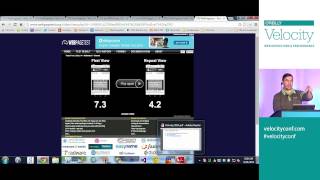 |
WebPagetest Power Users Part 1 and Part 2 – WebPagetest is one of the best performance tools out there. Pat Meenan, creator of WebPagetest, guides us through the new and advanced features. |
 |
Smooth Animation on Mobile Web, From Kinetic Scrolling to Cover Flow Effect – Ariya Hidayat does a deep dive into the best practices for smooth scrolling on mobile. |
 |
Encouraging Girls in IT: A How To Guide -Â Doug Ireton and his 7-year-old daughter, Jane Ireton, lament the lack of women represented in computer science and Jane’s adventure learning programming. |
If you enjoy catching up using video, I recommend you watch these and other videos from the playlist. If you’re more of the “in-person” type, then I recommend you register for Velocity New York now. While you’re there, use my STEVE25 discount code for 25% off. I hope to see you in New York!
WebPerfDays: Performance Tools
I just returned from Velocity Europe in London. It was stellar. And totally exhausting! But this post is about the other fantastic web performance event that took place after Velocity: WebPerfDays London.
WebPerfDays is like a day-long web performance meetup event. Aaron Kulick organized the first one last June right after Velocity US. He had the brilliant idea to grab webperfdays.org with the goal of starting a series of events modeled after DevOpsDay. The intent is for other people to organize their own WebPerfDays events. All the resources are meant to be shared – the website, domain, templates, Twitter handle, etc.
Stephen Thair continued the tradition by organizing last week’s WebPerfDays in London. It was held at Facebook’s new London office. They contributed their space on the top floor with beautiful views. (Sorry for the broken sofa.) WebPerfDays is an UNconference, so the agenda was determined by the attendees. I nominated a session on performance tools based on two questions:
What’s your favorite web performance tool?
What tools are missing?
Here are the responses gathered from the attendees:
Favorite Performance Tool:
- WebPagetest
- Cuzillion
- Chrome Dev Tools
- Speed Tracer
- Performance Analyzer from Site Confidence (pay)
- SPOF-O-Matic, 3PO for YSlow
- Wireshark
- PageSpeed, YSlow
- dynaTrace Ajax Edition and SpeedoftheWeb
- HTTP Archive
- Critical Path Explorer – part of PageSpeed Insights
- PhantomJS
- mobile remote debugging: Weinre, jsconsole.com, Opera Dragonfly, Chrome for Android
- Apache Bench (ab)
- Show Slow
- Browserscope
- Tilt, DOM Monster
- Mobileperf Bookmarklet
- chrome://net-internals
- Redbot
- SpriteMe
- Boomerang, Episodes
- wget, telnet
- Wappalyzer
- Netalyzer
- Shunra NetworkCatcher Express
- Packet Flight
- Fiddler, Charles
- CSS Lint, JSLint
- GTMetrix
Updates:
- Torbit Insight
- Grunt.js
- sitespeed.io
- SSL Server Test
- SPDY Indicator (Firefox, Chrome), SPDYCheck.org
- KITE, MITE
- Compass (CSS)
- Soke, Seige, Tsung (load testing)
- SpeedCheckr
Missing Tools:
- When analyzing a website need a tool that calculates the average delta between last-modified date and today and compare that to the expiration time. The goal is to indicate to the web developer if the expiration window is commensurate with the resource change rate. This could be part of PageSpeed, YSlow, and HTTP Archive, for example.
- Automated tool that determines if a site is using a blocking snippet when an async snippet is available. For example, PageSpeed does this but only for Google Analytics.
- Tools that diagnose the root cause for rendering being delayed.
- Easier visibility into DNS TTLs, e.g., built into Chrome Dev Tools and WebPagetest.
- Backend tool that crawls file directories and optimizes images. Candidate tools: Yeoman, Wesley.
- Nav Timing in (mobile) Safari.
- Better tools for detecting and diagnosing memory leaks.
- Web timing specs for time spent on JavaScript, CSS, reflow, etc. (available in JavaScript).
- Tools to visualize and modify Web Storage (localStorage, app cache, etc.).
- Tools to visualize and clear DNS cache.
- A version of JSLint focused on performance suggestions.
- A tool that can diff two HAR files.
Updates:
- in-browser devtools letting you drill into each resource fetched or cached, listing the full set of reasons (down to the combination of http headers at play in the current and, as applicable, a prior request) for why that resource was or wasn’t loaded from the cache, when it would get evicted from cache and why: https://bugs.webkit.org/show_bug.cgi?id=83986
This was stream of consciousness from the audience. It’s not an exhaustive list. Do you have a favorite web performance tool that’s not listed? Or a performance analysis need without a tool to help? If so, add a comment below. And consider organizing WebPerfDays in your area. Aaron, Stephen, and I would be happy to help.
Add your site & custom fonts
The Nov 15 2011 crawls for the HTTP Archive and HTTP Archive Mobile are done. Two new things were added.
Add your site
Our goal is to crawl the world’s top 1,000,000 URLs. This month we doubled the number of URLs from 17K to 35K. We’re still a ways away but making progress. But what if you’d like your website to be in the HTTP Archive but it isn’t in the top 1M?
Now you can add your site to the HTTP Archive. If it’s already in the list we’ll tell you and point you to any data that’s been gathered so far. If it’s not in the list we’ll queue it up for the next crawl. We moderate all additions to make sure the URL is valid. We also have a limit of 1 URL per website. We strive to crawl a site’s main URL (e.g., https://stevesouders.com/) but not all the subpages within a site (https://stevesouders.com/about.php, http://www.example.com/videos.php, etc.).
Custom Fonts
I’ve been thinking more about custom fonts after Typekit‘s acquisition by Adobe and seeing Jeff Veen at Velocity Europe. (Make sure to watch the video of Jeff’s talk – it’s an amazing presentation with a humorous start.) So this week I added a chart to track the adoption of custom fonts:
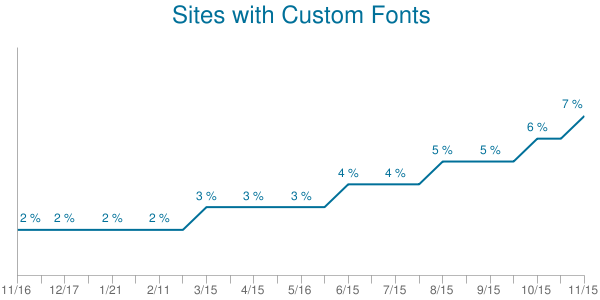
Typekit is clearly on to something – the use of custom fonts has tripled in one year. I warn against using @font-face for performance reasons, but performance isn’t all that matters. (Gasp!) Custom fonts obviously have aesthetic benefits that are attractive to website owners.
Fortunately, Typekit has several performance optimizations in how they load fonts. They combine all the fonts in a single stylesheet for browsers that support data: URIs. The fonts are served over a CDN. The font’s are only cacheable for 5 minutes which hurts repeat visits, but I believe they’re working on longer cache times.
For truly fast and robust font loading we need to lean on browser developers to implement better caching for fonts and better timeout choices during rendering. I’ll be talking about this during my High Performance HTML5 session at QCon on Friday.
Announcing my focus on mobile
For over a year I’ve been saying that I want to focus 100% of my time on mobile performance. I’m finally there. It might not be literally 100% of my time, but I hope to spend most of my research cycles investigating mobile.
My approach to building a practice around mobile performance will follow a similar path as what I did for desktop web:
- Measure
- Identify what to measure wrt performance and services to measure that.
- Profile
- Gather a set of tools that provide visibility into performance issues. Since there’s a lack of tools in this space we’ll have to build them.
- Research
- Analyze mobile performance problems using the identified tools and metrics.
- Best practices
- As a result of this research gather the tips & tricks that have the biggest impact on improving mobile performance.
- Evangelize
- Get the word out! Write case studies, blog posts, and books(?). Speak at conferences
- Lint
- Build tools that spot the performance problems that are most important to fix.
- Automate
- Provide services that automatically apply the performance fixes.
My initial focus is mobile devices over wifi. This allows me to nail down the behavior of mobile browsers independent of the wrinkles introduced by the mobile network. Once the mobile browser variables are well understood I’ll look at the idiosyncrasies of the mobile networks themselves. I’m especially excited to build an archive of transcoding behaviors that harm performance. I’ll dig into the performance of native apps once the behavior of mobile web performance is well understood.
I have a slightly ulterior motive for this announcement. I really want to speak at Mobilism May 12-13 in Amsterdam. (If you do mobile development make sure to register early.) Unfortunately, the speaker schedule is full so I have to convince the organizers I have enough good stuff to present that they need to somehow fit me into the schedule.
Tune back here tomorrow for my first announcement on mobile tools. (Assuming I finish it tonight.)
Velocity China
I returned from Velocity China yesterday. It was a great, great conference. It sold out with ~600 people – the main ballroom was standing room only for the morning keynoters. One thing I noticed that’s different in China – people fill in the seats from the front back, whereas in the US people have to be encouraged to move up to the front.
There were 35 sessions. I invited several speakers from the U.S.:
- Changhao Jiang (Facebook) talked about some of the performance projects he’s worked on including BigPipe, Quickling, and PageCache. This was a great talk covering a lot of material. He was mobbed with questions afterward:

- David Wei (also from Facebook) did two talks. The first was about managing static resources – caching, combining scripts, etc. The second was about the challenges of setting up a performance practice and culture within an organization such as Facebook. This is a topic I get asked about frequently and we need a talk like this at Velocity US.
- Doug Crockford (Yahoo!) did two talks as well. His first was Using JavaScript Well – a focus on the good parts of JavaScript. The second talk was called There and Back Again – a much needed presentation about the potential of JavaScript running on the server.
- Daniel Hunt (also from Yahoo!) did a talk on the performance optimizations behind the Yahoo! Mail rewrite. This also talked about serverside JavaScript and their use of the mustache templating system.
- Alex Nicksay (YouTube) described four specific performance improvements made to YouTube. This talk was great because he included quantified load time results for each improvement. He also talked about their UIX widget system when should be open sourced soon. The slides contain almost all the code anyway.
- I did two talks. One was a variation of my Even Faster Web Sites presentation with some new slides talking about how script loading has changed dramatically in just the last few years. My other talk was about the arrival of the WPO industry. This is a new talk that includes my view of the main phases of building an industry-wide focus on performance.
A special treat that I was able to pull together at the last minute was presentations from the Chrome, IE9, and Firefox 4 teams. These browser talks are always popular at the Velocity US conference. Web developers understand that having fast browsers is critical to improving the user experience, and these browser teams have responded with tremendous focus on performance the last few years.
The other sessions were arranged by my co-chair Zhang Wen Song (Taobao). The presentations in the main ballroom were translated to English, and I also sat through presentations in Chinese. The translated talks were very good mostly focusing on the operations side of Velocity – availability, scaling, CDNs, and more. I had trouble following the talks that were only in Chinese although slides that had code or charts are universal. But I could tell these were good speakers – they were at ease up on stage, they engaged the audience, and their slides looked good.
Here’s some of the back story around how Velocity China happened: Velocity China is the first conference O’Reilly has done in China. And it sold out! A great start. We held it in Beijing since O’Reilly has an office there. But it’s not a very big office – just four employees headed up by Michelle Chen. This team of four people organized their first conference and pulled off a great event. Huge credit to Michelle and her team. I got to meet all them – Douglas, Donna, and Jian – they were incredible hosts taking us out to dinner every night and arranging drivers and tours.
O’Reilly partnered with Taobao on Velocity China. It was critical to have someone building up the conference program direction and content from China. The co-chair, Zhang Wen Song, arranged the program and also delivered a great opening keynote. Joshua Zhu, also from Taobao, helped with emceeing many of the Chinese sessions.
I want to thank O’Reilly and Taobao for making Velocity China happen. I also want to thank all the people I met there. I was overwhelmed by the enthusiasm of the developers. Even with the language challenges, I had deep conversations during the breaks with attendees. There’s no doubt that performance is a big focus in China. With the success of this conference I’m confident we’ll be back again next year.

Web Directions South, Sydney photos
I just got back from Web Directions South in Sydney. John Allsopp and team do a great job. I and many others complimented John on pulling together great speakers at an awesome venue. I especially appreciated the smaller things he did to make a great conference – informal talks during lunch, great coffee and afternoon tea, and an incredible hack day called Amped. About a hundred folks were there on a Saturday creating amazing apps. The winning team, which included Tatham Oddie, built a conference app and also started a website dedicated to a conference data API standard – in one day.
The best talk for me was Tom Hughes-​​Croucher (@sh1mmer) talking about Doing Horrible Things to DNS. I’m not sure why he called it “horrible” – it’s actually a great performance gain. He described a technique for returning resolutions for multiple CNAMEs in a single response. This is a typical scenario for any web sites doing domain sharding. I also enjoyed watching a live release mid-session from Ben Schwarz (@BenSchwarz). He developed the W3 specification styles Greasemonkey script. Working with Michael Smith from the W3C, those styles are being incorporated into the specs themselves.
In addition to great speakers, there was an energetic vibe across all the attendees. The breaks were packed with great conversations and Q&A. I saw more of this JS community vibe the night before the conference when I attended SydJS. Over a hundred JavaScript developers packed the downstairs of the Atlassian offices for a panel of experts.
I spent Sunday sightseeing before flying home today. The sights and people were great. I want to share two photos:


On my walk back from Bondi Beach I passed through a neighborhood with this street sign for Sustainability Street with the added tagline “It’s a village out there.” A nice community boost in the middle of Sydney. At the Botanical Gardens this morning I enjoyed this sign at the entrance directing me to “Please walk on the grass.” I was further invited to “smell the roses, hug the trees, talk to the birds, and picnic on the lawns.” In the bottom right it says “Plants=Life”. It was a great final touch of Sydney before heading home.
Velocity: Top 5 Mistakes of Massive CSS
Nicole Sullivan and Stoyan Stefanov had the #3 highest rated session at Velocity – The Top 5 Mistakes of Massive CSS. Nicole (aka, “stubbornella”) wrote a blog post summarizing their work. The motivator for paying attention to CSS are these stats that show how bad things are across the Alexa Top 1000:
- 42% don’t GZIP CSS
- 44% have more than 2 CSS external files
- 56% serve CSS with cookies
- 62% don’t minify
- 21% have greater than 100K of CSS
Many of these problems are measured by YSlow and Page Speed, but the solutions still aren’t widely adopted. Nicole goes on to highlight more best practices for reducing the impact of CSS including minimizing float and using a reset stylesheet.
Checkout the slides and video of Nicole and Stoyan’s talk to learn how to avoid having CSS block your page from rendering.
| Choose Your Own Adventure | Adam Jacob | Opscode |
| TCP and the Lower Bound of Web Performance | John Rauser | Amazon |
| The Top 5 Mistakes of Massive CSS | Nicole Sullivan | Consultant |
| Building Performance Into the New Yahoo! Homepage | Nicholas Zakas | Yahoo! |
| Hidden Scalability Gotchas in Memcached and Friends | Neil Gunther | Performance Dynamics Company |
| Internet Explorer 9 | Jason Weber | Microsoft |
| Creating Cultural Change | John Rauser | Amazon |
| Scalable Internet Architectures | Theo Schlossnagle | OmniTI |
| Ignite Velocity | Andrew Shafer | Cloudscaling |
| The Upside of Downtime: How to Turn a Disaster Into an Opportunity | Lenny Rachitsky | Webmetrics/Neustar |
| Metrics 101: What to Measure on Your Website | Sean Power | Watching Websites |
| The 90-Minute Optimization Life Cycle: Fast by Default Before Our Eyes? | Joshua Bixby | Strangeloop Networks |
| Progressive Enhancement: Tools and Techniques | Anne Sullivan | |
| Chrome Fast. | Mike Belshe |
Back to blogging after Velocity
The last few weeks have been hectic. I was in London and Paris for 10 days. I returned a day before Velocity started. Most of you experienced or have heard about the awesomeness that was Velocity – great speakers, sponsors, and attendees. Right after Velocity I headed up to Foo Camp at O’Reilly HQ. This week I’ve been catching up on all the email that accumulated over three weeks.
During this time blogging has taken a backseat. But now that my head is above water I want to start relaying some of the key takeaways from Velocity. I wrote my Velocity wrap-up and mentioned my favorite sessions. But here are the top 10 sessions based on the attendee ratings:
- Choose Your Own Adventure by Adam Jacob, Opscode (unofficial video snippets)
- TCP and the Lower Bound of Web Performance by John Rauser, Amazon (slides)
- The Top 5 Mistakes of Massive CSS by Nicole Sullivan, consultant and Stoyan Stefanov, Yahoo! (video)
- Building Performance Into the New Yahoo! Homepage by Nicholas Zakas, Yahoo! (slides)
- Hidden Scalability Gotchas in Memcached and Friends by Neil Gunther Performance Dynamics and Shanti Subramanyam and Stefan Parvu, Oracle (video)
- Internet Explorer 9 by Jason Weber, Microsoft (slides)
- Creating Cultural Change by John Rauser, Amazon (video)
- Scalable Internet Architectures by Theo Schlossnagle, OmniTI (slides)
- The Upside of Downtime: How to Turn a Disaster Into an Opportunity by Lenny Rachitsky, Webmetrics/Neustar (video, slides)
- Tied for #10:
- Metrics 101: What to Measure on Your Website by Sean Power, Watching Websites (slides)
- The 90-Minute Optimization Life Cycle: Fast by Default Before Our Eyes? by Joshua Bixby and Hooman Beheshti, Strangeloop Networks
- Progressive Enhancement: Tools and Techniques by Anne Sullivan, Google (slides)
- Chrome Fast. by Mike Belshe, Google (slides)
Some things to highlight: Adam Jacob is an incredible speaker – insightful and funny. John Rauser is the speaker I enjoyed the most – he shows up twice at #2 and #7. Two of the browser presentations registered. The workshops this year were incredible and very well attended – four of them registered in the top 10 (#8, #10a, #10b, and #10c). Annie Sullivan rated high and it was her first time speaking at a conference.
The last two years at Velocity we’ve only been able to videotape the talks in one room, so this year that means about a third of the talks were videotaped. Four of these top rated sessions were taped. Next year I’ll try to get more of the top speakers in the video room. I’ve asked the five speakers without slides to upload them to the Velocity web site. Check back next week if you want those.
I actually feel electricity running up and down my spine looking over these talks. To think I had something to do with pulling these gurus together and offering a place for them to share what they know – it’s humbling and exhilarating at the same time. I’ll be doing some more Velocity-related posts on specific sessions next week, so stay tuned.
| Choose Your Own Adventure | Adam Jacob | Opscode |
| TCP and the Lower Bound of Web Performance | John Rauser | Amazon |
| The Top 5 Mistakes of Massive CSS | Nicole Sullivan | Consultant |
| Building Performance Into the New Yahoo! Homepage | Nicholas Zakas | Yahoo! |
| Hidden Scalability Gotchas in Memcached and Friends | Neil Gunther | Performance Dynamics Company |
| Internet Explorer 9 | Jason Weber | Microsoft |
| Creating Cultural Change | John Rauser | Amazon |
| Scalable Internet Architectures | Theo Schlossnagle | OmniTI |
| Ignite Velocity | Andrew Shafer | Cloudscaling |
| The Upside of Downtime: How to Turn a Disaster Into an Opportunity | Lenny Rachitsky | Webmetrics/Neustar |
| Metrics 101: What to Measure on Your Website | Sean Power | Watching Websites |
| The 90-Minute Optimization Life Cycle: Fast by Default Before Our Eyes? | Joshua Bixby | Strangeloop Networks |
| Progressive Enhancement: Tools and Techniques | Anne Sullivan | |
| Chrome Fast. | Mike Belshe |
Velocity wrap-up
Velocity ended yesterday at 6pm – and the final presentations from 5:20-6:00 were still packed! It was a great conference. I’m wiped out from talking web performance from 8am to 10pm the last three days.
The highlight of the conference was the conference itself:
- 1200 attendees
- 89 speakers
- 28 sponsors
- 26 exhibitors
Compare that to the numbers for Velocity 2008: 600 attendees, 65 speakers, 9 sponsors, 17 exhibitors. The growth is a testimonial for how the focus on web performance and operations has increased in just 2 years. Companies know their web sites have to be fast, available, and scalable. That’s why they come to Velocity.
We added a third track this year on Culture which meant I wasn’t able to attend every performance talk. But here are the talks I saw that really stood out:
- Creating Cultural Change (video) and TCP and the Lower Bound of Web Performance (slides) – John Rauser (Amazon) was the breakthrough speaker of the conference. Both talks not only had great content, they were also funny and delivered with style.
- Datacenter Infrastructure Innovation (video) – James Hamilton (Amazon) presents surprising stats about the true costs of infrastructure services.
- Speed Matters (video) РUrs H̦lzle (Google) evangelizes creating a faster web via a long list of performance initiatives. Make sure to check out the links at the end to SSL and congestion window improvements.
- The O’Reilly Radar (video, slides) – Tim O’Reilly leads the rally cry for the critical role of performance and operations to the future of the Web.
- Don’t Let Third Parties Slow You Down (video, slides) – Michael Kleber (Google) presents some great stats on the impact of 3rd party content, and at the end slips in some performance improvements he’s working on for Google AdSense.
- JSMeter: Characterizing Real-World Behavior of JavaScript Programs (slides) – Ben Zorn (Microsoft Research) reveals how unrepresentative today’s benchmarks are compared to real web sites. I really recommend you check out his charts.
- Building Performance Into the New Yahoo! Homepage (slides) – Nicholas Zakas (Yahoo!) provided a case study of adding advanced performance techniques including progressive enhancement.
There were other great talks such as The Top 5 Mistakes of Massive CSS and Google Maps API v3 – Built First for Mobile for which we’re still waiting for slides and possibly video. I encourage you to check out all the slides and videos – remember, I was only able to sit in on one of three tracks. There’s a lot more to see.
Thanks for making Velocity 2010 so amazing. I’ll see you at Velocity 2011! (Remember to register early!)