
Even Faster Web Sites
This post introduces Even Faster Web Sites, the follow-up to High Performance Web Sites. Posts in this series include: chapters and contributing authors, Splitting the Initial Payload, Loading Scripts Without Blocking, Coupling Asynchronous Scripts, Positioning Inline Scripts, Sharding Dominant Domains, Flushing the Document Early, Using Iframes Sparingly, and Simplifying CSS Selectors.
Last April, I blogged about starting a follow-up to my first book, High Performance Web Sites. Last week I sent in the first round of final edits. Although there will likely be one or two more rounds of edits, they should be small. So, I’m feeling pretty much done. It’s a huge weight off my shoulders. I’ve been working on this book for more than a year. The performance best practices I present required more research than HPWS. I also expanded my testing from just IE and Firefox (as I did in HPWS) to IE, Firefox, Safari, Chrome, and Opera (including multiple versions of each).
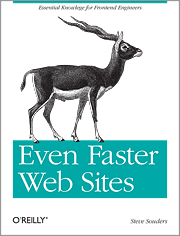
The title of this new book is Even Faster Web Sites. It will be published in June, and is available for pre-order now on Amazon and O’Reilly. The cover of HPWS was a greyhound. EFWS’ cover is the Blackbuck Antelope – it can hit 50 mph which is in the top 5 for land animals. (Fastest is cheetah, but that’s taken by Programming the Perl DBI.)
The most exciting thing about EFWS is that it includes six chapters from contributing authors. This came about because I wanted to have best practices for JavaScript performance. I’m a pretty good JavaScript programmer, but not nearly as good as the JavaScript luminaries out there who are writing books and teaching workshops. I also wanted a chapter on image optimization, where Stoyan Stefanov and Nicole Sullivan are the experts. I reached out to folks in these and other areas to contribute performance best practices that they had accumulated. The resulting chapters are listed below. I’ve indicated the contributing authors where appropriate; otherwise, the chapter is written by me.
- Understanding Ajax Performance – Doug Crockford
- Creating Responsive Web Applications – Ben Galbraith and Dion Almaer
- Splitting the Initial Payload
- Loading Scripts Without Blocking
- Coupling Asynchronous Scripts
- Positioning Inline Scripts
- Writing Efficient JavaScript – Nicholas C. Zakas
- Scaling with Comet – Dylan Schiemann
- Going Beyond Gzipping – Tony Gentilcore
- Optimizing Images – Stoyan Stefanov and Nicole Sullivan
- Sharding Dominant Domains
- Flushing the Document Early
- Using Iframes Sparingly
- Simplifying CSS Selectors
- Performance Tools
Between now and when the book comes out, I’ll write a blog post about each of my chapters. I wrote the first one of these, Split the Initial Payload, back in May. Now that I have more time on my hands, I’ll catch up and finish the rest.
If you’re just beginning the process of improving your web site’s performance, you should start with High Performance Web Sites. But as Web 2.0 gains wider adoption and the amount of content on web pages continues to grow, the best practices in Even Faster Web Sites are key to making today’s web sites fast(er).
Simone | 23-Apr-09 at 4:08 am | Permalink |
Is it available as rough cuts as well?
Rob | 23-Apr-09 at 7:10 am | Permalink |
I got a lot out of your previous book and look to see what great stuff this one has.
Weston Ruter | 23-Apr-09 at 8:03 am | Permalink |
Hey Steve, when should it be appearing on Safari Books Online?
Marcel Duran | 23-Apr-09 at 9:46 am | Permalink |
Hi Steve, good news your book is coming soon I can’t wait to get my copy.
Great book cover! I’ve seen on Animal Planet last week that the Tiger Beetle is technically the fastest running land animal, considering its body length.
“Michael Johnson would have to run a 200 meter race in 0.87 seconds to equal the relative quickness of the Australian species”
You could use it in a future book cover, just claim that before somebody else does ;-)
More info on:
http://en.wikipedia.org/wiki/Tiger_beetle
http://www.news.cornell.edu/releases/Jan98/TigerBeetle.bpf.html
cherouvim | 24-Apr-09 at 5:38 am | Permalink |
Great news! Just recently finished reading your previous book. Can’t wait to get this one as well!
thanks
Steve Souders | 24-Apr-09 at 1:37 pm | Permalink |
@Simone, @Weston: It should be on Rough Cuts and Safari Online next week.
sunnybear | 25-Apr-09 at 2:05 pm | Permalink |
Steve, I will be glad if you can mention webo.name (or webo.in) as a Russian initiative in Performance Tools chapter in your future book.
Max | 08-May-09 at 11:49 pm | Permalink |
Very much looking forward to this book!
Brian Gardner | 14-Oct-09 at 1:55 pm | Permalink |
I’m another fan of your first book. Just pre-ordered this one. It was a huge inspiration for my company GetSnappy.com
Ugur Eskici | 07-Apr-10 at 9:12 pm | Permalink |
Hi Steve, is it avaible on amazon? I wanna to buy it but idk where can i buy it.
Stuart | 08-Apr-10 at 12:52 am | Permalink |
http://www.amazon.com/Even-Faster-Web-Sites-Performance/dp/0596522304/ref=pd_bxgy_b_img_b
nandu | 19-Jan-12 at 1:53 am | Permalink |
i need to know why my games are so slow to load and how can i make it to load really fast can you tell me plz