
Web 2.0 Expo
I’ll be speaking at Web 2.0 Expo in San Francisco April 25 at 1:30pm. My talk is called Even Faster Web Sites. This is my next set of performance best practices including how to load scripts without blocking and the dangers of inline scripts. If you’re thinking of coming please the discount code “websf08sbg” to save an extra 10%.
Roundup on Parallel Connections
A lot of blogging and follow-up discussion ensued with the announcement that IE8 supports six connections per host. The blogs I saw:
- IE8: The Performance Implications
- IE8 speeds things up
- IE8: 6 Connections Per Host
- IE 8 and Performance
- Testing IE8.s Connection Parallelism
- IE 8 Connection Parallelism Issues
It’s likely that Firefox 3 will support 6 connections per server in an upcoming beta release, which means more discussion is expected. I wanted to pull all the facts into one place and make several points that I think are important and interesting. Specifically I talk about:
- the HTTP/1.1 RFC
- settings for current browsers
- upperbound of open connections (cool!)
- effect of proxies
- will this break the Internet?
Purple Hippo at SXSW
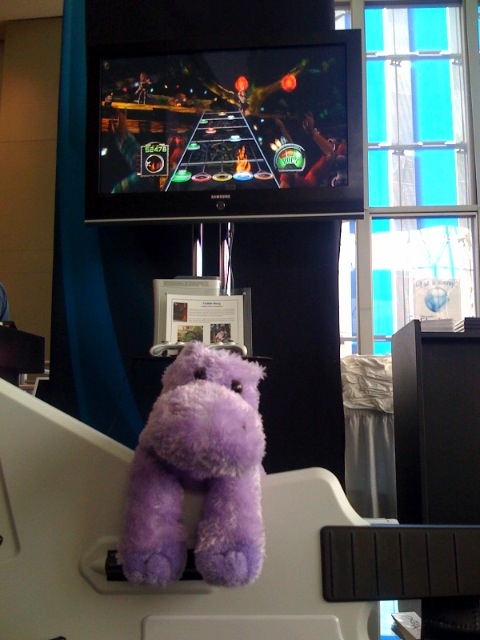
Fluff piece: I was at SXSW Interactive this past weekend. Just like that AT&T commercial, my youngest daughter (5 years old) snuck her purple hippo into my suitcase. It’s always hard leaving my girls behind. Emailing photos back via my iPhone made the trip easier for them and me.
Most of the action was on the 4th floor of the convention center, so everyday started with a long escalator ride. This was my first year at SXSW, but several veterans mentioned how sessions were spread out more than usual. Several times I saw Freddy Wong, the US Guitar Hero 3 Champion, rocking out. Purple hippo wanted some of that action.


IE8 speeds things up
IE8 Beta 1 has several performance improvements listed in the release notes. Many of these improvements center around the DOM and JavaScript execution. And their announcement about stricter standards compliance is a great move forward. There are three changes that are big and relate to my performance best practices: 6 downloads per hostname, loading scripts in parallel (the biggest improvement!), and support for data: URIs.
Google fosters a faster Internet
Wow. On Thursday Google announced that an advertiser’s web page load time will affect their ad’s position and minimum bid: Landing page load time will soon be incorporated into Quality Score. What a message to advertisers. If their page loads slowly they’ll be moved to a lower position in the sponsored links. This is a huge boost to the cause for faster web performance. I was pleased to see that this announcement has suggestions for improving page load times that include YSlow and my performance best practices. The next question: How do we motivate advertisers to improve the load time of the rich media ads they embed in our web sites? (posted from SXSW)
How green is your web page?
Writing faster web pages is great for your users, which in turn is great for you and your company. But it’s better for everyone else on the planet, too.
Intrigued by an article on Radar about co2stats.com, I looked at my web performance best practices from the perspective of power consumption and CO2 emissions. YSlow grades web pages according to how well they follow these best practices. What if it could convert those grades into kilowatt-hours and pounds of CO2?
Velocity Registration Now Open
Registration is now open for Velocity, the web performance and operations conference from O’Reilly. Velocity is scheduled for June 23-24 at the SFO Marriott in Burlingame, CA. Jesse Robbins and I are co-chairing. Several performance gurus are presenting. Topics covered include Ajax performance, CDNs, load balancing, measuring performance, and more. If you work in web performance or operations this is the event to make. The on-site registration price is $1595. If you register before May 5 it’s $1145. Use the discount code “vel08blg†to receive a 10% discount.
I hope to see you there!
-Steve